Philosophy & Ethics (inc. Religious Studies)
Philosophy & Ethics Department Curriculum intent
At The Buckingham School, the Philosophy and Ethics curriculum aims to give our students valuable insights into the diverse beliefs and opinions held by people today, in order to aid students’ own personal development and to support an understanding of the spiritual, moral, social and cultural questions that surface again and again in their lives. The study of Philosophy and Ethics encourages our students to explore and challenge their assumptions about what we are, how we think, and the nature of the world around us. Across all stages, we nurture well-rounded individuals who challenge stereotypes, promote cohesion and reject extremism. Above all, the Philosophy and Ethics curriculum encourages our students to value both themselves and the communities in which they live.
Central to our Philosophy and Ethics curriculum are the three core behaviours of Respect, Responsibility and Reflection. These values are embedded in all three Key Stages, with students learning to respect the beliefs of others, as well as of themselves, understanding their responsibilities as members of human society, and reflecting on their place in the world.
Key Stage 3: Engagement – Learning with Kindness and Curiosity
Our Key Stage 3 Philosophy and Ethics curriculum is designed to spark curiosity, encourage critical thinking, and actively engage students in exploring some of life’s most profound questions. Through thought-provoking discussions, real-world case studies, and creative learning experiences, we aim to make philosophy and ethics relevant and meaningful to our students. By presenting diverse viewpoints and contemporary ethical dilemmas, we invite students to form and articulate their own ideas while respecting others.
The Philosophy and Ethics curriculum introduces students to the beliefs, practices, and moral frameworks of major world religions and philosophical traditions. Through the study of diverse world-views, students learn to show respect for people of different faiths, cultures, and opinions. Lessons encourage students to take responsibility for their own ideas and behaviour by developing empathy, tolerance, and moral reasoning. Regular opportunities to discuss ethical dilemmas and explore “big questions” help students reflect on their own values, identity, and role in society, laying the foundation for respectful dialogue and personal growth.
Key Stage 4: Being Independent – Taking Responsibility for Learning and Growth
At Key Stage 4, our Philosophy and Ethics curriculum is designed to cultivate intellectual independence and personal responsibility in our students. We encourage learners to think for themselves, question assumptions, and engage critically and respectfully with complex philosophical and ethical issues. Through structured debate, extended writing, and reflective enquiry, students develop the confidence to form, defend, and refine their own viewpoints. Our curriculum empowers them to take ownership of their learning, fostering independent research skills and thoughtful self-expression. By promoting autonomy in thought and action, we prepare students not only for academic success, but for thoughtful engagement with the moral challenges of modern life.
Key Stage 5: Exemplary – Habitually Showing Integrity, Reflection, Responsibility and Respect
At Key Stage 5, our Philosophy and Ethics curriculum is designed to develop exemplary students—independent, intellectually curious, and ethically reflective young adults. We aim to cultivate high-level critical thinkers who can engage with complex philosophical arguments, analyse ethical theories with precision, and articulate their views with clarity and depth. Students show deep respect for the complexity of ideas and traditions that shape human understanding, and take full responsibility for their reasoning during structured debate.
Philosophy & Ethics department ethos
In Philosophy and Ethics, we create a learning environment where respect, responsibility, reflection, and kindness shape how we explore life’s big questions, how we treat one another, and how we grow — as thinkers, individuals, and members of a diverse society.
We uphold Responsibility
We take responsibility for how we think, speak, and act. In studying moral and philosophical issues, we recognise that our beliefs and actions carry consequences — for ourselves, for others, and for the world. We take ownership of our learning by engaging with complex ideas, forming reasoned arguments, and staying open to challenge and growth. Through respectful dialogue, we learn that responsible thinking includes listening, questioning, and being accountable for our words and choices.
We show Respect
Philosophy and Ethics asks us to engage deeply with different world views, religious traditions, and philosophical perspectives. We show respect by valuing these differences and treating all ideas — and the people who hold them — with fairness and dignity. Our classrooms are inclusive spaces where respectful debate and open enquiry help us better understand each other and the world we live in.
We practice Reflection
We reflect not only on what we believe, but why we believe it. Philosophy and Ethics encourages us to ask, “What kind of person do I want to be?” and “How do my values shape the way I live?” Through careful study and self-enquiry, we think critically about our assumptions, consider the impact of our choices, and grow in wisdom and self-awareness. Reflection helps us connect intellectual exploration with personal development.
We lead with Kindness
Kindness is essential to meaningful discussion. Whether exploring controversial issues or personal beliefs, we approach each other with empathy and compassion. We support one another in moments of uncertainty, challenge, and discovery. Through kindness, we build a learning community where everyone feels safe to express themselves, ask questions, and be heard.
We believe Philosophy and Ethics Matters
This subject helps us make sense of complex moral, spiritual, and philosophical issues — both timeless and contemporary. It encourages us to think clearly, argue respectfully, and live thoughtfully. We believe that Philosophy and Ethics equips students not just with knowledge, but with the character and compassion needed to thrive in a diverse and changing world.
Careers linked to philosophy & ethics
Careers in Philosophy and Ethics
- Philosophy and Ethics Teacher: Teaching Philosophy and Ethics in schools, from primary to secondary levels, is a primary career path.
- Chaplain: Providing spiritual guidance and support in various settings, including hospitals, schools, and universities.
- Religious Leader: Serving as a pastor, priest, rabbi, or similar role within a religious community.
- Higher Education Lecturer: Teaching Philosophy and Ethics at universities or colleges.
- Missionary: Working to spread religious beliefs and provide services in different cultures.
- Campus Religious Coordinator: Organising and coordinating religious activities and programs on university campuses.
Careers using Philosophy and Ethics
- Social Worker/Counsellor: Philosophy and Ethics studies can provide valuable insights into human behaviour, ethics, and social issues, making graduates well-suited for social work and counselling roles.
- Journalist/Media Professional: The ability to analyse complex texts, understand different perspectives, and communicate effectively are valuable in journalism.
- Human Rights Advocate/Victim's Advocate: Philosophy and Ethics can foster an understanding of ethical principles and human rights, making graduates well-equipped for these roles.
- Historian/Archivist: Philosophy and Ethics involves a study of religious history and the development of various beliefs, skills that can be applied to historical research and archival work.
- Legal Profession: Philosophy and Ethics graduates may find work in law firms, focusing on legal issues related to religion or religious institutions.
- Community Development Worker: Philosophy and Ethics can provide a foundation for understanding communities and developing programs that address social needs.
- Charity Fundraiser/Administrator: Philosophy and Ethics graduates can use their understanding of social issues and religious organisations to work in the charity sector.
further reading
Wider reading to support learning in Philosophy and Ethics lessons
Key Stage 3
Interfaith Reading List
Christianity
Fiction
- The Chronicles of Narnia – by C. S. Lewis
A classic fantasy series where the lion Aslan represents Christ-like themes such as sacrifice, redemption, and hope. - The Bronze Bow – by Elizabeth George Speare
Historical fiction set in Roman-occupied Judea, exploring themes of forgiveness and justice inspired by the teachings of Jesus.
Non-fiction
- The Jesus Storybook Bible – by Sally Lloyd-Jones
Retells Bible stories in a narrative style that shows how they connect to the story of Jesus. - Trailblazer Books – by Dave Jackson and Neta Jackson
Historical fiction for young readers featuring Christian figures and events from church history.
Buddhism
Fiction / Story collections
- I Once Was a Monkey: Stories Buddha Told – by Jeanne M. Lee
A collection of Jataka tales—stories about the Buddha’s previous lives that teach kindness, patience, and wisdom. - Anh’s Anger – by Gail Silver
A gentle story about handling anger through mindfulness, inspired by Buddhist teachings.
Non-fiction
- Becoming Buddha: The Story of Siddhartha – by Whitney Stewart
A biography of Siddhartha Gautama explaining how he became the Buddha. - Buddha Stories – by Demi
Illustrated stories about the Buddha’s life and teachings.
Sikhi
Fiction / Story-based
- Guru Nanak: The First Sikh Guru – by Demi
An illustrated story of the life of Guru Nanak and the founding of Sikhism. - The Story of the Golden Temple – by Rina Singh
A narrative introduction to the significance of the Harmandir Sahib and Sikh history.
Non-fiction
- My Religion and Me: We Are Sikhs – by Philip Blake
Explains Sikh beliefs, practices, and daily life in a way children can understand. - Sikhism – by Steffi Cavell-Clarke
A clear introduction to Sikh history, beliefs, and festivals.
Humanism / Ethics without Religion
Fiction
- The Little Book of Humanism – by Alice Roberts and Andrew Copson
Introduces humanist ideas about kindness, curiosity, and thinking for yourself.
Non-fiction
- What Do You Believe? – by DK
Explores religions and philosophies—including secular thinking and ethics. - The Belief Book – by David G. McAfee
Explains religion, atheism, and humanism in an accessible way for children.
Multi-faith books
- A Faith Like Mine – by Laura Buller
Introduces many world religions (including Buddhism, Sikhism, and Christianity) through the lives of children around the world. - The Kids Book of World Religions – by Jennifer Glossop
Explains beliefs, rituals, leaders, and places of worship across major religions. - One World, Many Religions: The Ways We Worship – by Mary Pope Osborne
A comparative introduction to major faith traditions for young readers.
Philosophy & Ethics Reading List (Key Stage 3)
Introductory Philosophy (Non-fiction)
The Philosophy Book (DK)
A visual guide explaining major philosophers and ideas (Socrates, Aristotle, Kant, existentialism) with diagrams and short explanations.
Big Ideas for Curious Minds – The School of Life
Introduces philosophy through big questions about happiness, kindness, work, and meaning.
What Do You Believe? – DK
Explores religion, ethics, and philosophy through questions about right and wrong, truth, and belief.
The If Machine – Peter Worley
Uses fun thought experiments (e.g., Would you clone yourself?) to explore philosophical thinking.
Think: A Compelling Introduction to Philosophy – Simon Blackburn
More advanced but still accessible for older KS3 readers interested in deeper philosophy.
Ethics and Moral Philosophy (Non-fiction)
How to Be Good – The School of Life
Discusses virtues such as honesty, kindness, and fairness with relatable examples.
The Belief Book – David G. McAfee
Introduces different belief systems and encourages thinking critically about ethics and values.
Ethics for Beginners – Brad Warner
A friendly explanation of ethical thinking and how moral decisions work.
Justice: What's the Right Thing to Do? (Young Reader ideas) – Michael Sandel
Some KS3 readers can engage with simplified ideas from Sandel’s famous ethics course.
Philosophical Fiction
Sophie's World – Jostein Gaarder
A novel that teaches the entire history of philosophy through a mysterious story about a girl receiving philosophical letters.
The Little Prince – Antoine de Saint-Exupéry
A philosophical fable about friendship, responsibility, love, and what really matters in life.
The Giver – Lois Lowry
Explores themes of freedom, morality, memory, and whether a perfectly controlled society is ethical.
The Curious Incident of the Dog in the Night-Time – Mark Haddon
Raises philosophical questions about truth, perception, and understanding other minds.
The Boy at the Back of the Class – Onjali Q. Raúf
Encourages reflection on justice, empathy, and how society treats refugees.
Thought-Experiment and Question Books
Would You Rather? Philosophy for Kids – various authors
Uses dilemmas and scenarios to explore moral choices.
The Big Think Book – School of Life
Encourages children to ask philosophical questions about identity, fairness, and happiness.
Philosophy for Kids – David White
Uses stories and questions to introduce philosophical inquiry.
Classic Philosophy Stories Adapted for Young Readers
Plato and a Platypus Walk into a Bar – Thomas Cathcart & Daniel Klein
Uses jokes to explain philosophical ideas.
Stories of Philosophy – adapted editions
Narrative introductions to major thinkers and their ideas.
KS4 Reading List: Christianity, Judaism & Islam
Christianity
Non-fiction
- Mere Christianity — C. S. Lewis
A classic explanation of Christian beliefs about morality, God, and the nature of faith. Accessible for thoughtful KS4 readers. - The Case for Christ (Student Edition) — Lee Strobel
Investigates historical evidence about Jesus from a journalistic perspective. - The Bible: A Story of God and All of Us — Roma Downey & Mark Burnett
A narrative overview of key biblical events that helps readers understand the structure of the Bible.
Fiction
- The Shack — William P. Young
A novel exploring suffering, forgiveness, and the nature of God. - The Screwtape Letters — C. S. Lewis
A satirical novel written as letters from a demon teaching another demon how to tempt humans—great for discussing morality and temptation.
Judaism
Non-fiction
- Night — Elie Wiesel
A powerful Holocaust memoir that raises profound questions about faith, suffering, and human responsibility. - Judaism: A Very Short Introduction — Norman Solomon
A concise overview of Jewish beliefs, history, and practices. - The Jewish Book of Why — Alfred J. Kolatch
Explains Jewish customs and traditions through questions and answers.
Fiction
- The Chosen — Chaim Potok
A coming-of-age novel about friendship, faith, and identity within Jewish communities. - The Devil’s Arithmetic — Jane Yolen
A time-travel story about a Jewish girl transported to a Holocaust-era concentration camp, exploring memory and identity.
Islam
Non-fiction
- No God but God — Reza Aslan
An accessible history of Islam and the life of the Prophet Muhammad. - Islam: A Very Short Introduction — Malise Ruthven
A clear overview of Islamic beliefs, practices, and history. - Muhammad: Man and Prophet — Adil Salahi
A detailed biography of the Prophet Muhammad suitable for older teens.
Fiction / Memoir
- Persepolis — Marjane Satrapi
A graphic memoir about growing up in Iran during the Islamic Revolution. - Does My Head Look Big in This? — Randa Abdel-Fattah
A YA novel about a Muslim teenager in Australia deciding to wear the hijab.
Comparative Religion & Ethics
These books help students compare the three Abrahamic religions.
Non-fiction
- The Religions Book — DK
Visual explanations of major religious ideas including Christianity, Judaism, and Islam. - God Is Not One — Stephen Prothero
Explains how the world’s religions answer different human problems. - A Short History of the World’s Religions — Christopher Partridge
Accessible overview of religious traditions and their development.
Philosophy & Ethics Reading List (Key Stage 4 and Key Stage 5)
Philosophy Introductions (Non-fiction)
A Little History of Philosophy – by Nigel Warburton
A clear narrative journey through the history of philosophy from Socrates to modern thinkers. Short chapters make it ideal for GCSE-level readers.
The Stone Reader: Modern Philosophy in 133 Arguments – edited by Peter Catapano and Simon Critchley
A collection of short essays from contemporary philosophers exploring questions about morality, consciousness, and political philosophy.
How to Be a Philosopher – by Gary Cox
Encourages students to think philosophically about everyday problems such as happiness, identity, and truth.
Ethics and Moral Philosophy (Non-fiction)
Ethics: A Very Short Introduction – by Simon Blackburn
A concise explanation of ethical theories such as utilitarianism, virtue ethics, and moral relativism.
The Righteous Mind – by Jonathan Haidt
Explores why people disagree about morality and politics, introducing psychological perspectives on ethics.
Justice: What’s the Right Thing to Do? – by Michael J. Sandel
Uses real-life moral dilemmas to explain ethical theories and debates about fairness, rights, and responsibility.
Philosophical Fiction
Lord of the Flies – by William Golding
Explores human nature, morality, and whether civilisation truly restrains human cruelty.
Never Let Me Go – by Kazuo Ishiguro
Raises deep ethical questions about human dignity, medical ethics, and what it means to be human.
The Ones Who Walk Away from Omelas – by Ursula K. Le Guin
A powerful short story often used in philosophy classes to debate utilitarianism and moral responsibility.
Brave New World – by Aldous Huxley
Examines freedom, happiness, social control, and the ethics of technological society.
Philosophy Through Memoir and Real Life
Man's Search for Meaning – by Viktor E. Frankl
A profound reflection on suffering, purpose, and existential philosophy based on experiences in Nazi concentration camps.
Justice
Pairs well with Sandel’s lectures and explores moral reasoning using real-world examples.
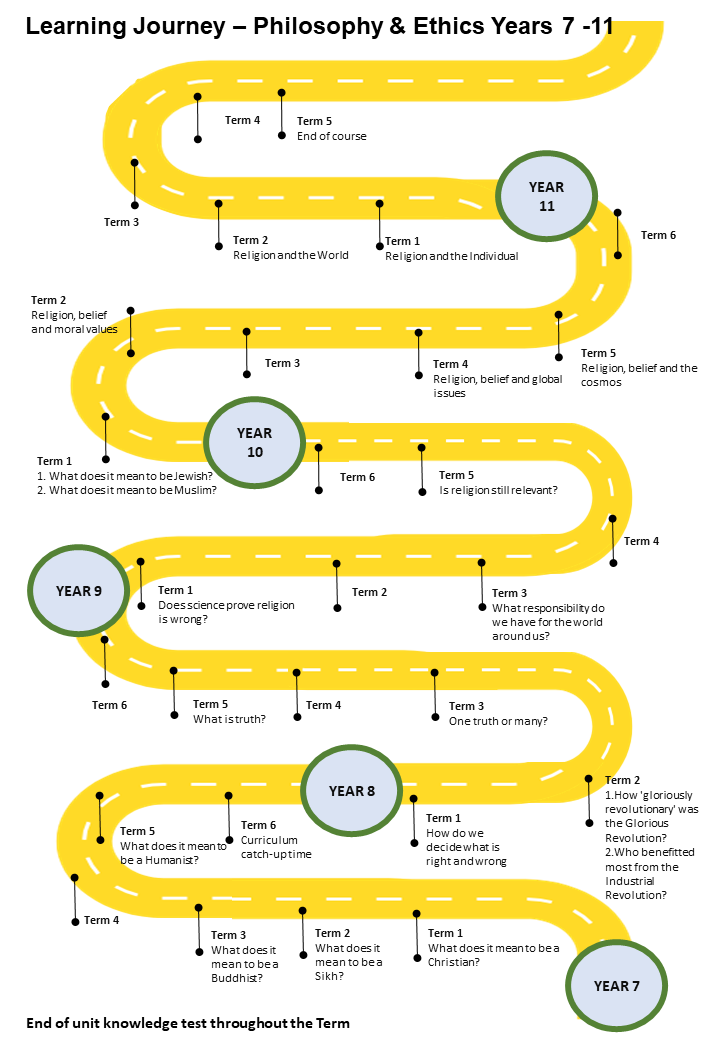
Learning journey
Parental Right to Withdraw from Religious Education (Philosophy and Ethics)
In accordance with Section 71 of the School Standards and Framework Act 1998, parents and carers have the legal right to withdraw their child wholly or partly from Religious Education (RE).
Parents/carers are not required to give a reason for requesting withdrawal. However, we encourage parents to discuss any concerns with the Headteacher before making a final decision, so that we can explain the aims, content and inclusive nature of the RE curriculum.
If a pupil is withdrawn from RE, the school will ensure that appropriate supervision is provided. The school is not required to provide alternative curriculum provision during the time the pupil is withdrawn.
Requests for withdrawal should be made in writing to the Headteacher, stating whether the request is to withdraw from the whole RE curriculum, or only from specific content areas.